

Is Your AI Guessing? How Custom Picklists Cost RevOps Its AI ROI
/5 minute read
Author - @GisselleNunez
RevOps teams are under pressure to prove the return on their AI investments. Yet many AI initiatives underdeliver for a reason that has nothing to do with the AI itself: the CRM picklists feeding it. Low-quality custom picklist values quietly tax every forecast, routing rule and agent that RevOps builds.
AI Meets Our Imperfect World
AI forms its operational and strategic recommendations from patterns learned across data from millions of businesses and end users. The language models behind today's AI assistants learned the vocabulary of business from an enormous body of public text. Benchmarking and predictive tools learn from how deals, cases and customers behave at scale. Either way, AI is fluent in the shared language of business, not in yours.
In a perfect world, every business would categorize a high-value opportunity the same way. In a slightly less perfect world, at least every industry would. In our reality, not even every niche of market share does.
Picture the perfect world. Every CRM in every company tracks deals with the same picklists:
Opportunity Type: New Business, Expansion, Renewal
Stage: Prospecting, Qualification, Discovery, Proposal, Negotiation, Closed Won, Closed Lost
Lead Source: Inbound Web, Referral, Partner, Event, Outbound
Loss Reason: Price, Competitor, No Decision, Timing, Product Fit
The AI already knows what Negotiation means. It knows a Renewal behaves differently from New Business, and that a Referral from an existing customer tends to close faster than a cold Outbound lead. It doesn't need a glossary. It can compare this pipeline against everything it has learned about pipelines like it, and the answer is useful on day one.
The RevOps Cost of Picklist Jargon
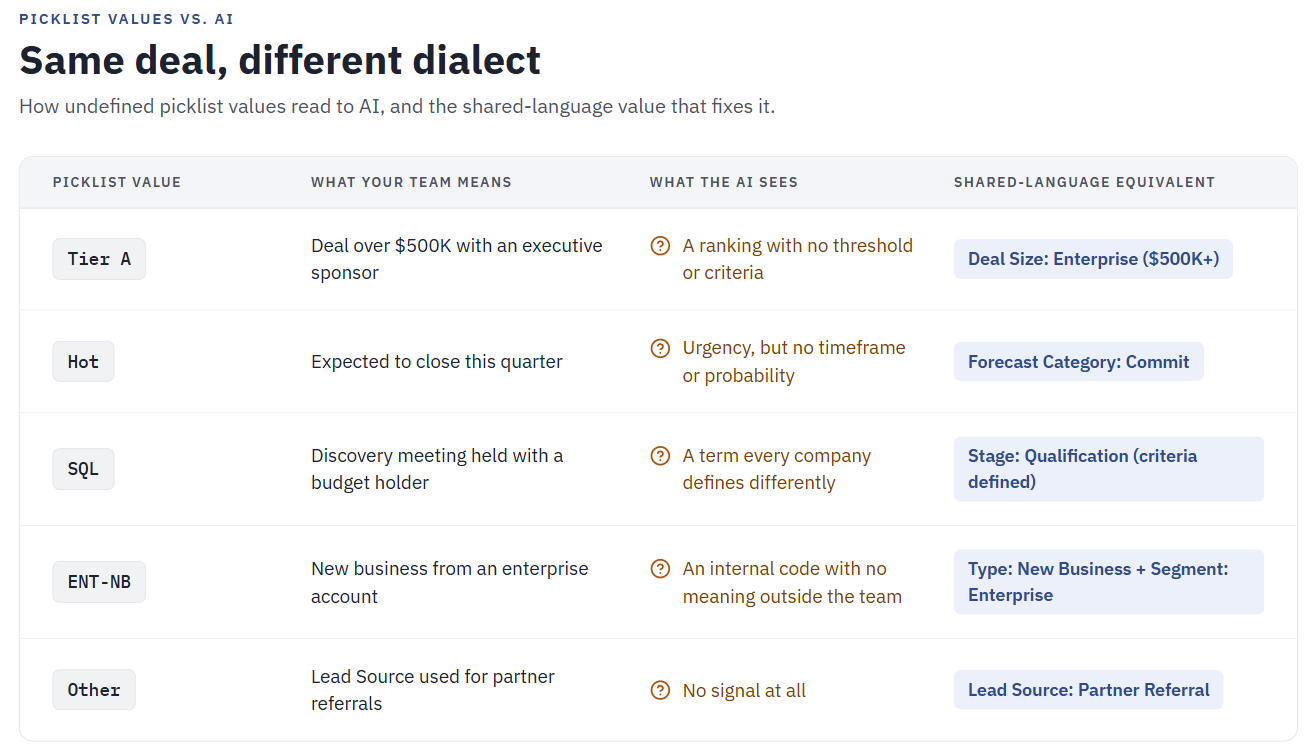
Every time a business turns internal jargon into a picklist value, it trades short-term comfort for long-term AI value, and RevOps pays the difference. The label makes sense to the sales floor. To the AI it's noise, and that noise surfaces in forecasts, dashboards and board decks.
Here's what that looks like in a real CRM:
How Does It Cost RevOps?
1. Your AI budget pays for translation
A model can't reason about a value it doesn't understand. At best, it ignores the field. At worst, it infers a meaning that sounds right and is wrong. "Code Red" could be read as a support escalation, a compliance issue or a hot deal. Every one of those guesses produces a confident, misleading recommendation.
2. Your forecast runs on diluted signal
Internal language rarely stays consistent even within one company. Over a few years, one concept splinters into "Referral," "Partner Referral," "Ref – Customer" and "Referral" (typo included). Each value holds a slice of the same signal. A predictive model sees four small, weak categories instead of one strong one. Lead scoring, win probability and attribution all lose accuracy, and the forecast call inherits the error. Legacy values make it worse. The AI trains on years of data where the same deal type was labeled three different ways, for example.
3. You can't benchmark your pipeline
The most valuable strategic question RevOps can bring to the CRO is "How do we compare?" Win rates by stage, cycle length by deal type, churn by segment. None of those comparisons work if your stages and types don't map to anyone else's. Your revenue data becomes an island: useful for describing last quarter, weak at guiding next year's plan.
4. Agents misroute revenue
AI agents don't just summarize data. They route cases, prioritize pipelines, trigger follow-ups and draft outreach, often based directly on picklist values. When a value is ambiguous, the agent's action is ambiguous. A renewal flagged "Code Red" might never reach the retention playbook because the agent was built to look for "At Risk."
5. The cost compounds across the portfolio
For multi-entity organizations and private equity portfolios, the problem scales fast. Five portfolio companies with five private dialects means five translation layers before any cross-company AI insight is possible. Roll-up reporting, shared forecasting models and portfolio-wide agents all stall at the same place: nobody agreed on what a qualified opportunity is called.
AI is only as smart as the categories you give it, and in most companies RevOps owns those categories. Before you fund the next AI initiative, fix the picklists. It may be the cheapest AI performance upgrade on your roadmap.
If you’d like to learn how to best build and maintain your RevOps Data playbook, reach out! info@techsolves.com